[Télécharger] Electric Powertrain: Energy Systems, Power Electronics and Drives for Hybrid, Electric and Fuel Cell Vehicles de John G. Hayes Livre eBook France
Télécharger Electric Powertrain: Energy Systems, Power Electronics and Drives for Hybrid, Electric and Fuel Cell Vehicles de John G. Hayes Livre eBook France
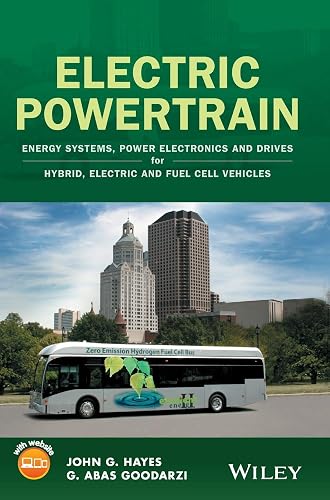
Télécharger "Electric Powertrain: Energy Systems, Power Electronics and Drives for Hybrid, Electric and Fuel Cell Vehicles" de John G. Hayes livre En ligne
Auteur : John G. Hayes
Catégorie : Livres anglais et étrangers,Professional & Technical,Engineering
Broché : * pages
Éditeur : *
Langue : Français, Anglais
The why, what and how of the electric vehicle powertrain Empowers engineering professionals and students with the knowledge and skills required to engineer electric vehicle powertrain architectures, energy storage systems, power electronics converters and electric drives.The modern electric powertrain is relatively new for the automotive industry, and engineers are challenged with designing affordable, efficient and high-performance electric powertrains as the industry undergoes a technological evolution. Co-authored by two electric vehicle (EV) engineers with decades of experience designing and putting into production all of the powertrain technologies presented, this book provides readers with the hands-on knowledge, skills and expertise they need to rise to that challenge. This four-part practical guide provides a comprehensive review of battery, hybrid and fuel cell EV systems and the associated energy sources, power electronics, machines, and drives. The first part of the book begins with a historical overview of electromobility and the related environmental impacts motivating the development of the electric powertrain. Vehicular requirements for electromechanical propulsion are then presented. Battery electric vehicles (BEV), fuel cell electric vehicles (FCEV), and conventional and hybrid electric vehicles (HEV) are then described, contrasted and compared for vehicle propulsion. The second part of the book features in-depth analysis of the electric powertrain traction machines, with a particular focus on the induction machine and the surface- and interior-permanent magnet ac machines. The brushed dc machine is also considered due to its ease of operation and understanding, and its historical place, especially as the traction machine on NASA's Mars rovers. The third part of the book features the theory and applications for the propulsion, charging, accessory, and auxiliary power electronics converters. Chapters are presented on isolated and non-isolated dc-dc converters, traction inverters, and battery charging. The fourth part presents the introductory and applied electromagnetism required as a foundation throughout the book. - Introduces and holistically integrates the key EV powertrain technologies. - Provides a comprehensive overview of existing and emerging automotive solutions. - Provides experience-based expertise for vehicular and powertrain system and sub-system level study, design, and optimization. - Presents many examples of powertrain technologies from leading manufacturers. - Discusses the dc traction machines of the Mars rovers, the ultimate EVs from NASA. - Investigates the environmental motivating factors and impacts of electromobility. - Presents a structured university teaching stream from introductory undergraduate to postgraduate. - Includes real-world problems and assignments of use to design engineers, researchers, and students alike. - Features a companion website with numerous references, problems, solutions, and practical assignments. - Includes introductory material throughout the book for the general scientific reader. - Contains essential reading for government regulators and policy makers. Electric Powertrain: Energy Systems, Power Electronics and Drives for Hybrid, Electric and Fuel Cell Vehicles is an important professional resource for practitioners and researchers in the battery, hybrid, and fuel cell EV transportation industry. The book is a structured holistic textbook for the teaching of the fundamental theories and applications of energy sources, power electronics, and electric machines and drives to engineering undergraduate and postgraduate students. Textbook Structure and Suggested Teaching Curriculum This is primarily an engineering textbook covering the automotive powertrain, energy storage and energy conversion, power electronics, and electrical machines. A significant additional focus is placed on the engineering design, the energy for transportation, and the related environmental impacts. This textbook is an educational tool for practicing engineers and others, such as transportation policy planners and regulators. The modern automobile is used as the vehicle upon which to base the theory and applications, which makes the book a useful educational reference for our industry colleagues, from chemists to engineers. This material is also written to be of interest to the general reader, who may have little or no interest in the power electronics and machines. Introductory science, mathematics, and an inquiring mind suffice for some chapters. The general reader can read the introduction to each of the chapters and move to the next as soon as the material gets too advanced for him or her. Part I Vehicles and Energy Sources Chapter 1 Electromobility and the Environment Chapter 2 Vehicle Dynamics Chapter 3 Batteries Chapter 4 Fuel Cells Chapter 5 Conventional and Hybrid Powertrains Part II Electrical Machines Chapter 6 Introduction to Traction Machines Chapter 7 The Brushed DC Machine Chapter 8 Induction Machines Chapter 9 Surface-permanent-magnet AC Machines Chapter 10: Interior-permanent-magnet AC Machines Part III Power Electronics Chapter 11 DC-DC Converters Chapter 12 Isolated DC-DC Converters Chapter 13 Traction Drives and Three-phase InvertersChapter 14 Battery Charging Chapter 15 Control of the Electric Drive Part IV Basics Chapter 16 Introduction to Electromagnetism, Ferromagnetism, and Electromechanical Energy Conversion The first third of the book (Chapters 1 to 6), plus parts of Chapters 14 and 16, can be taught to the general science or engineering student in the second or third year. It covers the introductory automotive material using basic concepts from mechanical, electrical, environmental, and electrochemical engineering. Chapter 14 on electrical charging and Chapter 16 on electromagnetism can also be used as a general introduction to electrical engineering. The basics of electromagnetism, ferromagnetism and electromechanical energy conversion (Chapter 16) and dc machines (Chapter 7) can be taught to second year (sophomore) engineering students who have completed introductory electrical circuits and physics. The third year (junior) students typically have covered ac circuit analysis, and so they can cover ac machines, such as the induction machine (Chapter 8) and the surface permanent-magnet ac machine (Chapter 9). As the students typically have studied control theory, they can investigate the control of the speed and torque loops of the motor drive (Chapter 15). Power electronics, featuring non-isolated buck and boost converters (Chapter 11), can also be introduced in the third year. The final-year (senior) students can then go on to cover the more advanced technologies of the interior-permanent-magnet ac machine (Chapter 10). Isolated power converters (Chapter 12), such as the full-bridge and resonant converters, inverters (Chapter 13), and power-factor-corrected battery chargers (Chapter 14), are covered in the power electronics section. This material can also be covered at the introductory postgraduate level. Various homework, simulation, and research exercises are presented throughout the textbook. The reader is encouraged to attempt these exercises as part of the learning experience. Instructors are encouraged to contact the author, John Hayes, direct to discuss course content or structure.
Télécharger Electric Powertrain: Energy Systems, Power Electronics and Drives for Hybrid, Electric and Fuel Cell Vehicles de John G. Hayes Pdf Ebook
Electric vehicle (EV) drivetrain system - Infineon ~ It controls the electric motor and is a key component in electric cars, as it determines the driving behavior, similar to the Engine Management System in combustion vehicles. In the main inverter, semiconductors transform the direct current from the battery into the alternating current that drives the motor. Less energy is lost this way, providing a longer range.
Components and Systems for Electric Vehicles (HEVs/EVs ~ Electric powertrain components have advanced through refinements in power electronics and microprocessors, and will continue to evolve as automotive power units. Hitachi is working to help protect the environment by developing products that meet the needs of the expanding market for vehicles that are compatible with the environment.
Winpower Software Downloads - Electrical and Industrial ~ This unique software provides complete power protection for your computer equipment during a power failure. With the software users can monitor any UPS status on the same LAN. Furthermore, a UPS can provide security protection for more than one computer on the same LAN at the same time, such as shutting down the system security, saving application data and shutting down the UPS when power fails.
Electric & Hybrid Vehicle Technology Expo ~ The Electric & Hybrid Vehicle Technology Expo is presented in partnership with The Battery Show and together they bring more than 350 international suppliers to Stuttgart. Combined, the two shows make up Europe’s largest H/EV and advanced battery technology trade fair, making it the leading meeting place for the latest powertrain technology in the e-mobility industry.
Electric & Hybrid Vehicle Technology News / Magazine ~ Electric & Hybrid Vehicle Technology International is firmly established as the world’s leading international showcase for technology and innovation in electric, hybrid and fuel-cell vehicle development and manufacture.
Dana Electrified / The Power Behind the Power Ahead ~ Dana’s TM4 brand offers low- and high-voltage electric motors, generators, power electronics, and control systems used in electric propulsion systems across all mobility markets. The brand was a pioneer in the development of electric propulsion system technology, and today, powers many of Dana's e-Propulsion systems and more.
Welcome to SEA Electric – SEA the Future ~ Battery electric power-systems for commercial vehicles is now available through SEA Electric, an automotive technology company which has developed a proprietary, 100% electric power-system (known as SEA-DriveTM). Our technology is adaptable to most commercial truck cab/chassis and delivery van models and is available in most countries around the world.
International Journal of Electrical Power & Energy Systems ~ The scope covers modelling of power system elements, their design, analysis of their performance and their implementation in specific aspects typical for modern electrical power and energy systems of various size and complexity. Research focused on new technologies changing power systems and determining their performance and operation is of particular interest. The following list of topics is .
48V: electric motor, lithium-ion battery, converter ~ Electrical supply; the energy stored in the 48V lithium-ion battery is flowing through the 48V DCDC converter to supply the vehicle electrical network; Valeo 48v hybrid system: a decrease of CO2 emissions. These new features bring strong benefits in CO 2 emissions and fuel economy. To complete the offer the 48V electric supercharger can be .
Electric Boosting Technologies - BorgWarner ~ Equipped with high-performance electric motors, the company’s cutting-edge solutions developed for 12V, 48V and high-voltage vehicles offer fast time-to-torque for a fun-to-drive experience while enabling improved fuel efficiency and reducing emissions. Some of the systems are also capable of recovering energy for additional efficiency benefits.
Motiv Power Systems - Motiv Power Systems ~ Motiv Power Systems is freeing fleets from fossil fuels by providing a seamless pathway to electrification. Our EV technology is Ford eQVM-approved, CARB-certified, uses high-volume commercial-scale batteries, and is available for many configurations including step vans, box trucks, work trucks, shuttle buses, school buses, trolleys, and other specialty vehicles.
YASA Limited / First for efficient electric powertrain. E ~ YASA’s revolutionary compact, lightweight and powerful electric motors and controllers enable vehicle hybridization and electrification – especially when there is limited powertrain space. The very short axial length and high power density of YASA e-motors make them a particularly effective solution for P2 type hybrid vehicles and range-extending modules as well as for P4 traction.
Electric Vehicle Battery Thermal Issues and Thermal ~ Electric vehicles (EVs) (battery or fuel cell) Micro hybrids (start/stop) Mild hybrids (start/stop + kinetic energy recovery) Full hybrids (medium hybrid capabilities + electric launch) Plug-in hybrids (full hybrid capabilities + electric range) Medium hybrids (mild hybrid + engine assist ) Axes not to scale . 5 Battery Requirements for Different EDVs Vehicle . Power (kW) Energy (kW/h) Cycles .
Power Electronics and Power Systems • Electrical and ~ The Electric vehicle system is comprised of electric motor, power electronics converters, and energy storage devices such as batteries. In addition, the overall system must be optimized to maximize overall system efficiency. Finally, to reduce the overall transportation emissions, the vehicle energy storage device should be recharged at times when the grid power production is most efficient .
Electric Vehicle Basics / Department of Energy ~ This distinguishes them from hybrid electric vehicles, which supplement an internal combustion engine with battery power but cannot be plugged in. There are two basic types of EVs: all-electric vehicles (AEVs) and plug-in hybrid electric vehicles (PHEVs). AEVs include Battery Electric Vehicles (BEVs) and Fuel Cell Electric Vehicles (FCEVs). In addition to charging from the electrical grid .
eTransportation - Journal - Elsevier ~ eTransportation focuses on advancing knowledge in all modes of transportation which use electricity as a main source of energy, including electric vehicles, electric trains, electric ships and electrical aircrafts.The journal covers all stages of research, development and testing of new technologies, systems and devices within the field of application of electrical transportation.
Electric vehicles - Australian Renewable Energy Agency (ARENA) ~ Plug-in hybrid electric vehicles (PHEVs): these vehicles are powered by a combination of fuel and electricity. They can be charged with electricity using a plug but also contain an internal combustion engine that uses liquid fuel ; Fuel cell electric vehicles (FCEVs): these vehicles use a fuel cell instead of a battery, or in combination with a battery or supercapacitor, to power their .
How Do Fuel Cell Electric Vehicles Work Using - Energy.gov ~ How Do Fuel Cell Electric Vehicles Work Using Hydrogen? Like all-electric vehicles, fuel cell electric vehicles (FCEVs) use electricity to power an electric motor.In contrast to other electric vehicles, FCEVs produce electricity using a fuel cell powered by hydrogen, rather than drawing electricity from only a battery. During the vehicle design process, the vehicle manufacturer defines the .
Inverters and Converters in Hybrids and EV (Electric Vehicles) ~ In a hybrid and other electric vehicles (EVs), two key elements work together to manage power and recharge the circuits. Here is how these critical components—the inverter and converter—work .
Fuel Cell and Battery Electric Vehicles Compared - Energy.gov ~ The specific energy of hydrogen and fuel cell systems compared to the specific energy of various battery systems . Compressed hydrogen and fuel cells can provide electricity to a vehicle traction motor with weights that are between eight to 14 times less than current. 2 . The compressed hydrogen tanks and fuel cell data are based on the following parameters: fuel cell power of 60 kW, FC .
Alternative Fuels Data Center: How Do Hybrid Electric Cars ~ Hybrid electric vehicles are powered by an internal combustion engine and an electric motor, which uses energy stored in batteries. A hybrid electric vehicle cannot be plugged in to charge the battery. Instead, the battery is charged through regenerative braking and by the internal combustion engine. The extra power provided by the electric motor can potentially allow for a smaller engine. The .
Electric Bus / EV Bus / Zero-Emission Bus / EV-Star by ~ GreenPower delivered the first EV Star electric bus in 2018, and has sold these vehicles to a number of customers, including UC San Francisco, the Port of Oakland, Sacramento Regional Transit, Creative Bus Sales and others. EV STAR SPECIFICATIONS . The BEAST Type-D Electric School Bus . Utilizing GreenPower’s high-floor platform, clean-sheet design and monocoque body, the Synapse is North .
Is a hybrid, electric or hydrogen fuel-cell vehicle right ~ Is a hybrid, electric or hydrogen fuel-cell vehicle right for you in 2019? Roadshow’s ultimate guide to the wide world of hybrids, plug-ins, EVs and more.
Vitesco Technologies - Vitesco Technologies. ~ Vitesco Technologies develops innovative, efficient powertrain technologies for all types of vehicle. Our portfolio includes 48-volt electrification solutions, electric drives, and power electronics for hybrid and battery-electric vehicles. Furthermore, the product range counts electronic controls, sensors and actuators as well as solutions for exhaust after-treatment. Vitesco Technologies .


Comments
Post a Comment